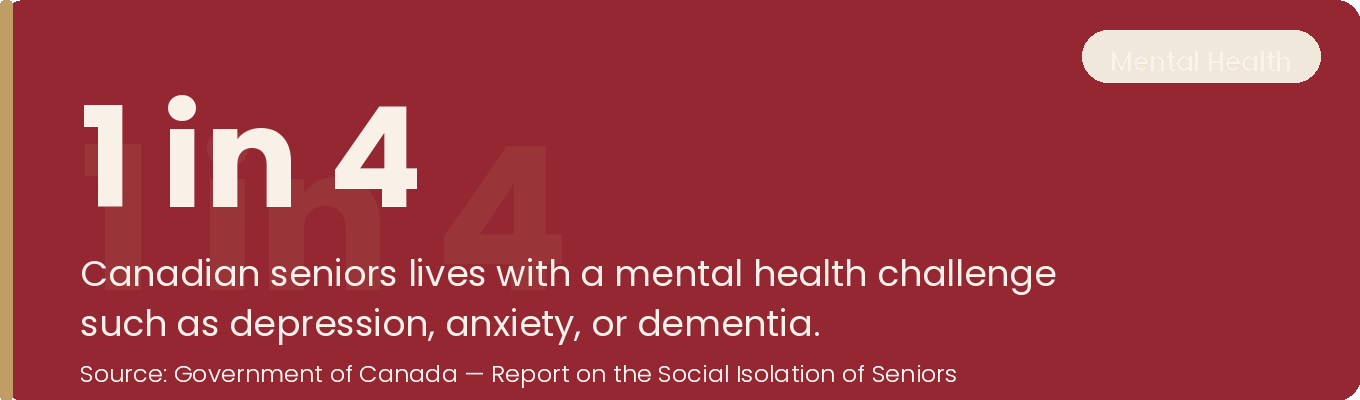
Research shows many older adults grow more emotionally resilient with age. But grief, loneliness, and financial stress can quietly undo that. Here is what the research actually says, what gets in the way, and where to find support in Peel.
Your mother calls on a Sunday like she always does. She says she is fine. But the call ends a little sooner than usual, and something about it stays with you.
She used to ask about the grandchildren. She used to have small updates about her week. Now she mostly says she is tired.
She probably is tired. But it may not be only that.
It could be quiet sadness. It could be worry about money, or the loss of a friend she has not talked about. Sometimes it is harder to name. Days that once felt full can begin to feel long and empty.
This is how it often shows up.
Not as a crisis. Not as something obvious. More like a slow pulling inward that deepens over time if no one notices.
We wrote this article for families like yours, and for seniors themselves. It brings together what research says about emotional health in later life, what can make things harder in Peel, what actually helps, and how support can be found. You can also watch this video on depression and older adults.
The research has good news, and it is worth knowing
Many people assume that emotional life becomes more difficult with age. In reality, the research points in a different direction.
In long-term studies, older adults often report greater emotional stability. This does not mean life is easier. It means people become better at holding different feelings at the same time.
Someone may still feel deep grief after losing a spouse, and in the same moment, find themselves laughing at a grandchild’s joke. One feeling does not cancel out the other.
There is also a connection to physical health. People who experience more positive emotion in their daily lives tend to live longer, even when their starting health is taken into account.
Researchers have also noticed patterns in people who age well. They tend to be more intentional with their time, stay curious, and continue to invest in relationships, including small daily interactions that might seem minor but are not.
Another important idea is meaning. This simply means feeling that your life still matters. Seniors who feel this tend to have better physical health, slower changes in memory, and lower rates of depression.
This is not about pretending things are fine. It is about staying connected to a sense that your life still has value.
The potential for genuine well-being in later life is real. It is also fragile. Certain circumstances can quietly erode it, and in Peel, many seniors are living inside exactly those circumstances. |
What makes it harder: the real picture in Peel
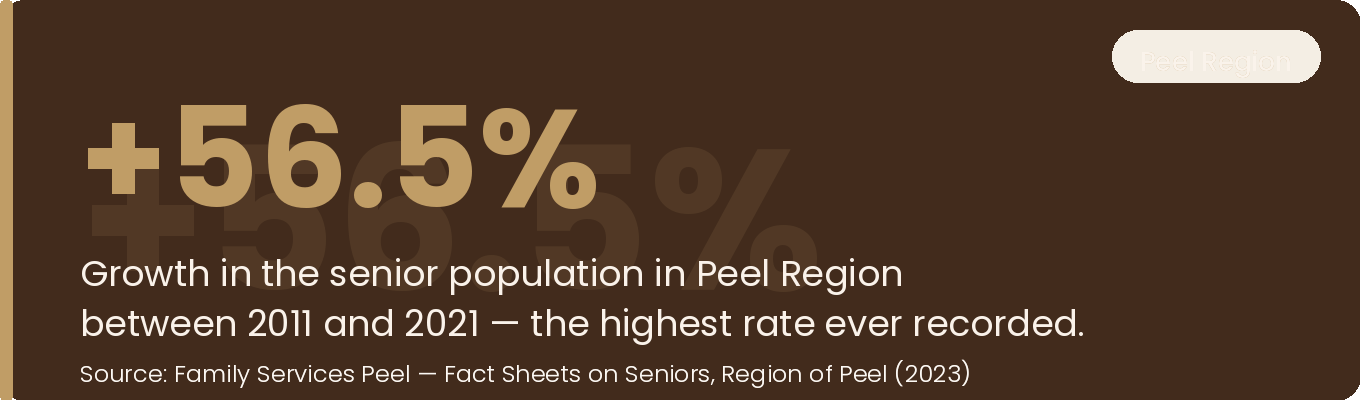
Peel Region is aging quickly. Between 2011 and 2021, the senior population has seen tremendous growth. In Mississauga, seniors now make up about 17% of the population. That means many older adults are living through this stage of life at the same time. Many need support, and many are not sure where to find it. Services are stretched. Costs are rising. And many seniors are not sure if support is meant for them.
Money stress does not stay financial
Mr. Edwards worked all his life. Now, after rent and medication, there is very little left at the end of each month. At night, he lies awake going over the numbers again and again.
In Peel, about 13% of seniors live below the poverty line. For those receiving Ontario Works or ODSP, the gap between income and the cost of living is not small. It is something they feel every day. This kind of stress does not stay contained to finances. It affects sleep, mood, and a person’s sense of stability. When someone is unsure how they will cover basic needs, the worry tends to stay with them.
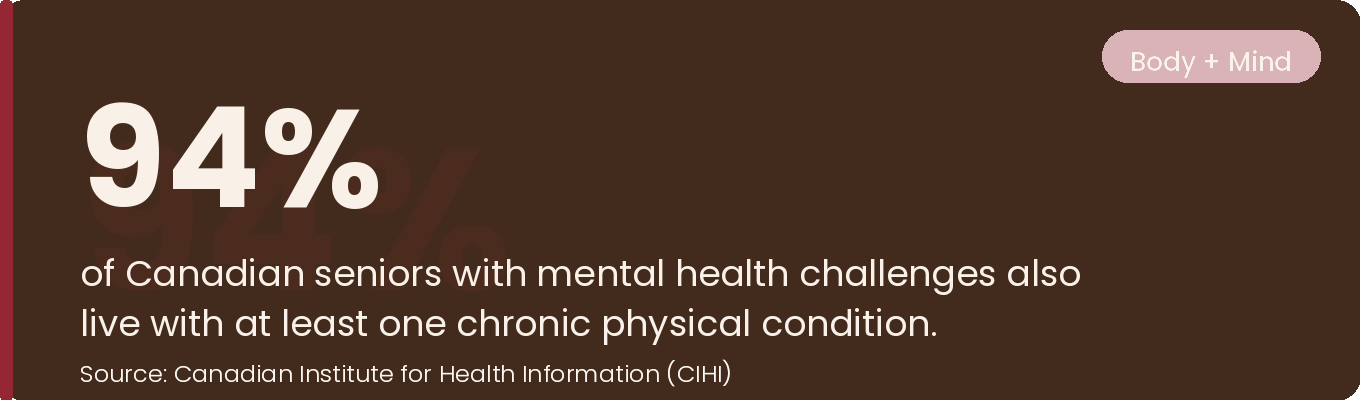
Physical health often adds another layer. Many seniors live with chronic conditions such as arthritis, diabetes, or heart disease. These can bring pain, fatigue, and limits on mobility, which makes it harder to stay active and connected.
Grief that nobody talks about
Ask any therapist who works with older adults and they will tell you the same thing: grief is the most common and least discussed issue in the room. Not only the grief of losing a spouse or a sibling, though that is real and significant. Also the quieter losses: the role of being the parent with children at home, the job that gave shape to the week, the friend group that has slowly dispersed, the version of yourself that was physically capable of things you can no longer do.
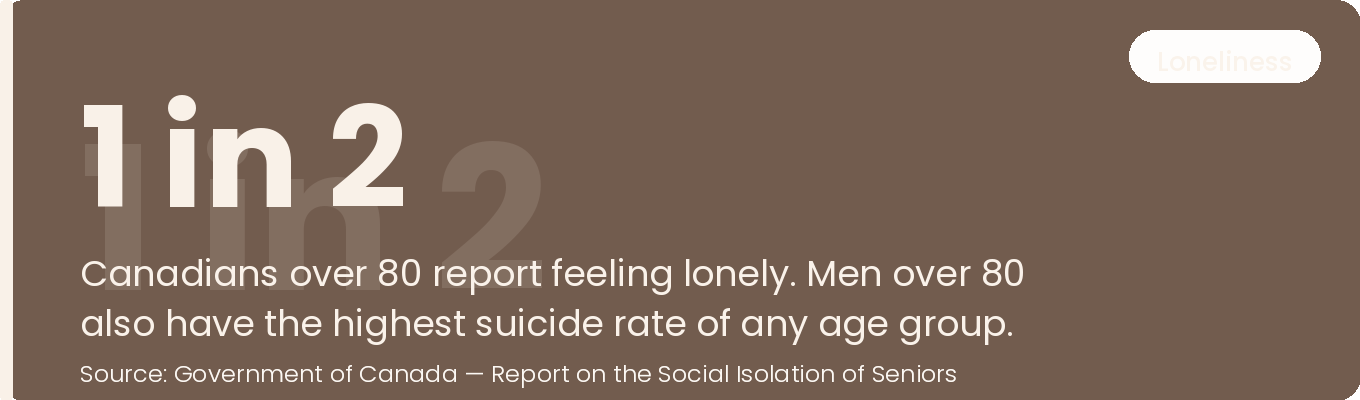
In Peel, 21% of seniors live alone. Nationally, about half of all Canadians over 80 report feeling lonely. Loneliness is not a character flaw or a sign of social failure. It is a documented health risk, linked to higher rates of depression, memory problems, and early death. Research has found it does as much damage to physical health as smoking heavily.
What makes grief harder in older adults is that it often goes unacknowledged. Family members are busy. The losses can seem, from the outside, like “just part of aging.” And many older adults have spent a lifetime putting other people’s needs first. They do not want to be a burden. So they say they are fine. And the grief compounds. You can visit our video resources page and watch a video that explains how grief differs from depression, what normal and complicated grief might look like.
When language and culture are barriers
For seniors whose first language is not English, everything becomes harder. Health information may not be available in their language. Service providers may not understand their culture or faith. Mental health can carry stigma in many communities. This makes it harder to explain what they are feeling and harder to ask for help.
Peel is one of the most diverse regions in Canada. Many seniors are managing emotional struggles without support that fits their life. Not because help does not exist, but because it does not always meet them where they are.
The thought that says “it is too late”
Beyond external pressures, many seniors carry something internal that quietly works against them. It is the voice that says: I am too old to try that. I should not still want things. It is too late to change. In therapy, it tends to sound like: I am just a burden now. Or: my children have their own lives; I should not bother them.
This kind of thinking is not weakness. It is what happens when a person absorbs, for decades, cultural messages that treat aging as decline. And it is treatable. But it has to be named first.
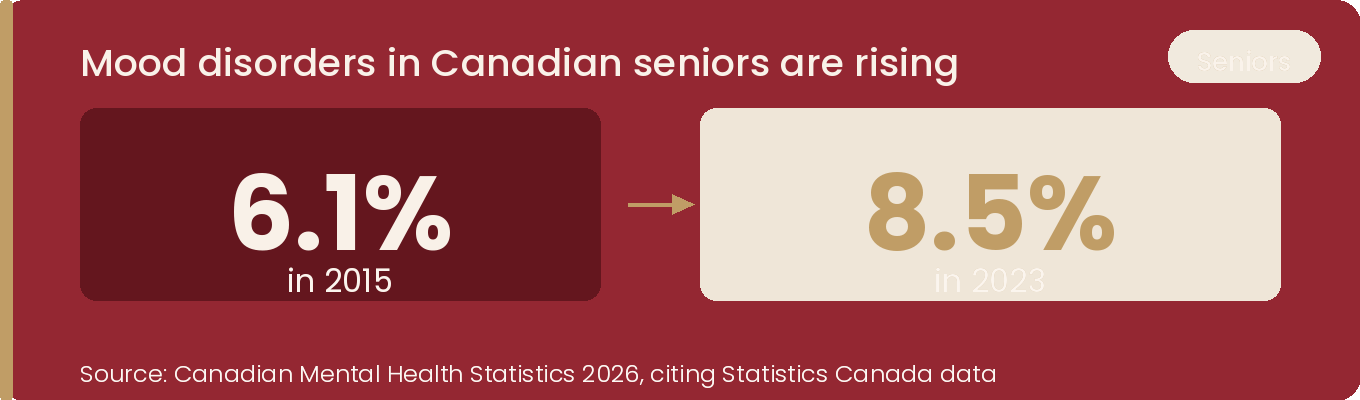
Mood disorders (ongoing problems with low mood or strong worry) among Canadian seniors increased from 6.1% in 2015 to 8.5% in 2023. That rise almost certainly reflects not just more seniors, but more seniors carrying difficult circumstances without adequate support.
What actually helps
The research points clearly toward what makes a genuine difference in later life. These are not prescriptions. They are things we have seen work, backed by evidence, and worth knowing about.
Your experience is a resource, not just history
One of the least talked-about gifts of aging is perspective. The ability to see past an immediate crisis because you have lived through hard seasons before. The capacity to hold grief and joy at the same time without being destroyed by either. The knowledge, earned and tested, that difficult things can end.
Researcher Laura Carstensen’s work, linked in the sources below, found that this emotional complexity, the ability to hold more than one feeling at once, tends to improve with age. Most older adults have more of it than they realise. In counselling, part of the work is helping people recognise and use what they already carry.
Small routines matter more than they seem to
When a person’s social world contracts, often because of health, loss, or circumstances, daily routines become more important, not less. Not grand plans or bucket lists. The things that give shape to a day: a walk at the same time each morning, a phone call with family, reading in your first language for half an hour, attending a weekly program at a community centre or church. For one grandmother, this looked like a 10‑minute phone call with a friend every night after dinner.
For seniors on tight incomes, many of the things that help most are free or nearly free. What matters is doing them with some intention, rather than letting the days run together.
Mindfulness and faith, which overlap more than people think
Mindfulness is often presented as a trend with a subscription fee. At its core, it is simply paying attention to what is happening right now, without trying to fix or escape it. For seniors managing anxiety, sleeplessness, or the loop of replaying worries, that kind of deliberate attention can genuinely interrupt the pattern. It does not require a class or an app. A few minutes of quiet breathing, a familiar prayer said with full attention, a slow walk where you notice what is around you: these all count.
For many seniors in Peel, faith practice already provides this. Prayer, worship, community ritual, the sense that life is held by something larger than the immediate difficulty: these carry real protective benefits, and research supports what many older adults have known from lived experience. At Cornerstone, we offer Christian faith-integrated counselling because we believe a therapist who understands a client’s spiritual context can go further than one who works around it.
Connection, close and everyday
Strong relationships are one of the most well-researched factors in long-term health and well-being. But it is not only deep relationships that matter. Research shows that even brief, casual interactions, a regular conversation with the person at the pharmacy counter, a familiar face at a weekly gathering, contribute meaningfully to a sense of belonging. For seniors whose close social world has contracted, rebuilding those everyday connections is often where the recovery of well-being begins.
Support in the spaces where community already exists
Many seniors will not walk into a counselling clinic on their own. The barriers are real: stigma, transportation, cost concerns, and uncertainty about what therapy involves. What often helps is hearing about support from someone they already trust, in a place that already feels familiar.
This is why Cornerstone works with churches, cultural centres, and community organizations. We bring mental health support into the spaces where seniors already gather.
What we offer your organization
We partner with faith communities and community organizations to provide workshops and presentations on the topics that matter most to older adults and their families. These sessions are designed to feel like a conversation. They use plain language, make room for questions, and respect that mental health carries real stigma in many communities. Our goal is not to push anyone toward formal therapy. It is to reduce that stigma, share practical tools, and make it easier for someone to take a next step when they feel ready.
Topics we cover include:
- Grief and loss: recognising it, naming it, and finding a way through
- Managing anxiety, low mood, and sleep challenges
- The health effects of loneliness and how to address them
- Mindfulness practices that complement everyday faith routines
- Recognising depression in older adults, which often looks different than in younger people
- How to support an aging parent or spouse who is struggling emotionally
- Navigating the health and social services system in Peel, with multilingual support available
- Emotional resilience and meaning-making in later life
For organizations that want more than a single session, we can develop a structured wellness series, typically delivered over several weeks, that builds on these themes in a way that fits your community’s schedule and context.
Sessions are available in person at your location or online. English, French, and Arabic are available, and we welcome conversations about other language needs based on your community’s makeup.
Getting started does not require a formal agreement. A single workshop is a meaningful first step. If it lands well, we build from there. Referrals flow naturally from these partnerships: when a senior hears about support from someone they already trust, the barrier to reaching out drops significantly.
If you lead or coordinate programming for a church, mosque, cultural centre, or any community organization serving seniors in Peel, we would welcome a conversation. There is no cost to your organization for an initial discussion.
The conversation that opens the door to help often happens not in a therapy office, but in a church hall, around a community kitchen table, or in a circle of familiar faces. |
Free individual counselling for Peel seniors
For seniors who want one-on-one support, Cornerstone offers free individual counselling to Peel residents receiving Ontario Works or ODSP, including older adults.
Sessions are available in English, French, and Arabic. We offer both in-person appointments at our Mississauga office and online sessions, so transportation and mobility do not have to be barriers.
Every therapist at Cornerstone holds a master’s degree and is a Registered Psychotherapist regulated by the College of Registered Psychotherapists of Ontario (CRPO). Our Clinical Director holds a PhD and a Doctorate in Counselling and Psychotherapy. This is qualified, regulated, accountable care.
In sessions, older adults work with a therapist to process grief they may have been carrying alone for years, to understand and manage anxiety or low mood, and to challenge the persistent thought that says it is too late to matter. For seniors whose first language is not English, being able to speak in their own words, with a therapist who understands their cultural and faith background, is often itself a form of relief.
No doctor’s note is required. No referral. Seniors can contact us directly, or a family member, community worker, physician, or settlement agency can reach out on their behalf.
If you are reading this for someone you love
Most seniors will not ask for help. Not because they do not need it, but because they are used to putting others first. Or because they genuinely believe, after absorbing years of messages about aging, that they do not deserve it.
If your mom, dad, or grandparent has become quieter, has pulled back from things they used to enjoy, has said “what’s the point” more than once, or seems to be running on empty: please do not wait for them to come to you. This is not just aging. It is a sign that something hurts. You can call us on their behalf. You can sit with them and look at the website together. You can ask a community leader they trust to mention that free support exists.
If you have a parent or grandparent whose first language is not English and who has never found mental health services that felt right for them, let them know that sessions at Cornerstone are available in English, French and Arabic, with a therapist who understands where they are coming from. That matters more than most people realise.
Asking for help is not a burden on the system. It is one of the most practical things an older adult can do for their health, and for the people who love them.
Getting started
Aging brings real loss. It also brings something that is harder to name but just as real: a kind of depth, a perspective on what matters, a resilience that many older adults carry without fully recognising it in themselves.
The research does not promise that later life is painless. It says clearly that meaningful change is possible at any stage, that connection and purpose protect health in ways that physical care alone cannot, and that the people most likely to age well are not the ones who avoided difficulty. They are the ones who had somewhere to take it.
If any part of this article speaks to your situation, or to someone you know, reach out. We are here.
Sources
- Carstensen, L.L. et al. (2011). Emotional experience improves with age: Evidence based on over 10 years of experience sampling. Psychology and Aging, 26(1), 21–33. https://www.ncbi.nlm.nih.gov/pmc/articles/PMC3332527/
- Holt-Lunstad, J. et al. (2015). Loneliness and social isolation as risk factors for mortality: A meta-analytic review. Perspectives on Psychological Science, 10(2), 227–237. https://pubmed.ncbi.nlm.nih.gov/25910392/
- Statistics Canada (2025). Mood disorders among older Canadians. Health Reports, 36(12). https://www150.statcan.gc.ca/n1/pub/82-003-x/2025012/article/00002-eng.htm
- Canadian Institute for Health Information (CIHI). Canadian seniors and mental health. https://www.cihi.ca/en/canadian-seniors-and-mental-health
- Government of Canada, National Seniors Council (2014). Report on the social isolation of seniors. https://www.canada.ca/en/national-seniors-council/programs/publications-reports/2014/social-isolation-seniors/page05.html
- Family Services Peel (2023). Fact sheets on seniors in the Region of Peel. https://fspeel.org/wp-content/uploads/2023/07/Fact-Sheets-on-Seniors-MRLL100723-Final-Version.pdf