
Most of us would never speak to a friend the way we sometimes speak to ourselves.
“That was so stupid.”
“I can’t do anything right.”
“Why can’t I just get it together?”
And then there are the quieter ones. The ones that don’t sound like attacks but do just as much damage.
“If I were just a little smarter…”
“If only I had started sooner.”
“I’m not the kind of person who…”
“Everyone else seems to manage this.”
Those ones are harder to catch. They sound almost reasonable. That is exactly what makes them stick.
If any of that sounds familiar, you are not alone. Self-talk, the running conversation you have with yourself inside your own head, is something every person has. The question is whether yours is helping you or working against you.
That inner voice may not be telling you the truth about who you are. It is probably telling you a story built from years of experience, things you were told, patterns you absorbed, moments that left a mark. And the research is clear that it affects far more than your mood. It shapes how you handle pressure, how you make decisions, how you show up in your relationships, and even your physical health.
This guide covers all of it: what self-talk actually is, why the critical voice develops, what it costs you when it runs unchecked, and practical steps that actually work to change it.
In this article:
- What Is Self-Talk?
- Self-Talk vs. Self-Delusion: An Important Distinction
- Positive vs. Negative Self-Talk: Examples You’ll Recognise
- 4 Common Myths About Self-Talk
- Why Negative Self-Talk Is So Common
- What Negative Self-Talk Does to Your Health
- The Real Benefits of Positive Self-Talk
- 8 Practical Steps to Improve Your Self-Talk
- When the Inner Critic Gets Loud: A Simple In-the-Moment Process
- How Self-Talk Travels Through Families
- When to Get Help
- References
What Is Self-Talk?
Self-talk is the internal commentary running through your mind throughout the day. It colours how you interpret situations, how you respond to what happens around you, and the conclusions you draw about yourself and your life. Sometimes it sounds like narration. Sometimes it sounds like a verdict.
Most self-talk is automatic. We do not consciously choose it. It develops over years, shaped by the people who raised us, the relationships we have been in, and the messages we absorbed from school, community, and culture. A child who was regularly compared to a sibling, criticised harshly for mistakes, or taught that love was conditional may carry those messages into adulthood as an internal voice that sounds a lot like fact.
When you hear “you are not good enough” in your own head, it does not feel like a story someone told you once. It feels like the truth. But it is a conclusion drawn from experience, not a fact about who you are.
And conclusions can change. That is what the rest of this article is about.
Self-Talk vs. Self-Delusion: An Important Distinction
Before going further, there is something worth clearing up, because it stops a lot of people from taking positive self-talk seriously.
Positive self-talk is not pretending the problem does not exist. It is not telling yourself your performance was great when you know it was not. It is not denial. And it is definitely not the kind of hollow cheerfulness that feels completely disconnected from what you are actually going through.
Here is the difference between three things that often get confused:
Self-delusion: “That presentation went great!” (when you know it didn’t, and you are not looking at why)
Toxic positivity: “Just stop being so negative. Everything will be fine!” (dismissing real pain without addressing it)
Positive self-talk: “That didn’t go the way I wanted. What can I take from it?”
Positive self-talk is honest. It acknowledges what happened. It just refuses to pile on and turn a hard moment into a permanent story about your worth. It treats you the same way a fair and caring person would: clear about what occurred, without turning it into something bigger than it is.
Clinical Psychological Science confirms that this kind of honest, grounded reframing is what actually reduces stress and builds resilience over time. Not forced positivity. Fairness.
Keep that distinction in mind as you read on. We are not trying to trick your brain. We are trying to help it be fair to you.
Positive vs. Negative Self-Talk: Examples You’ll Recognise
Self-talk lives on a spectrum, and most people move between positive and negative patterns depending on the situation, how tired they are, and what else is going on in their lives. The examples below are not here to judge you. They are here to help you recognise your own patterns.
You make a mistake at work
Negative: “I’m so incompetent. Everyone must think I’m useless.”
Positive: “I made a mistake. I’ll figure out what went wrong and do better next time.”
You’re about to try something new
Negative: “I’m going to embarrass myself. I don’t know what I’m doing.”
Positive: “I haven’t done this before, but I can learn.”
A relationship ends
Negative: “Something must be wrong with me. No one will ever want to be with me.”
Positive: “This is painful. It doesn’t mean I’m not worthy of connection.”
You feel overwhelmed
Negative: “I can’t cope. This is too much. I’m falling apart.”
Positive: “I’m having a hard time right now. What’s one small thing I can do?”
Notice how the negative versions tend to close things down. A single difficult moment becomes a permanent verdict: “I made a mistake” becomes “I am a failure.” “I am struggling right now” becomes “I will always struggle.” The positive versions stay honest about the difficulty without turning it into a conclusion about who you are.
If some of those negative examples sounded familiar, that makes sense. But the last thing you need right now is to criticise yourself for being self-critical. That just adds another harsh thought on top of the others. The goal is to get better at noticing these patterns, and later in this article, we will walk through exactly how to do that.
4 Common Myths About Self-Talk
Self-talk comes with a lot of baggage. Some people dismiss it as motivational fluff. Others feel guilty for not being more positive. Before getting into what the research actually shows, it helps to clear away a few things that tend to get in the way.
Myth 1: Struggling with negative self-talk means you’re weak.
Negative self-talk is tied to how the brain processes stress and perceived threats, and it is shaped significantly by life experience. It has nothing to do with personal strength or character.
In fact, many people who struggle the most with a harsh inner critic are deeply conscientious, caring individuals. They hold themselves to a high standard, they feel things deeply, and they care about getting things right. They will go to great lengths for others but rarely extend that same care to themselves. When that gets pointed out, most people recognise it immediately.
Myth 2: Positive self-talk is mainly for athletes and motivational speakers.
Sport psychology has done a great deal of research on self-talk, and that is where many people first encounter the concept. But the same mechanisms that help a competitive swimmer stay focused through a tough race or help a public speaker stay grounded before walking on stage are at work in everyday life.
When an athlete talks themselves through a difficult moment, “you have trained for this, stay with it,” they are doing something specific: interrupting the pattern of self-doubt before it takes over their performance. The same process applies when a parent is struggling to stay patient, when someone is sitting in a job interview, when a person is trying to get through a hard conversation without shutting down.
Self-talk affects how you make decisions, handle conflict, feel about your relationships, and see your own worth. It does not matter whether you are an athlete or just trying to get through a regular Tuesday.
Myth 3: You can just decide to think better thoughts.
If it were that simple, no one would struggle with it. Negative self-talk is often deeply automatic and tied to emotional patterns that developed over many years. Deciding to stop doing it is a bit like deciding not to be afraid of something that genuinely frightens you. The intention is there, but wanting to stop is not the same as knowing how. Changing it takes learning specific skills. For many people, it also means working through what gave rise to it in the first place.
Myth 4: Positive self-talk means ignoring your problems.
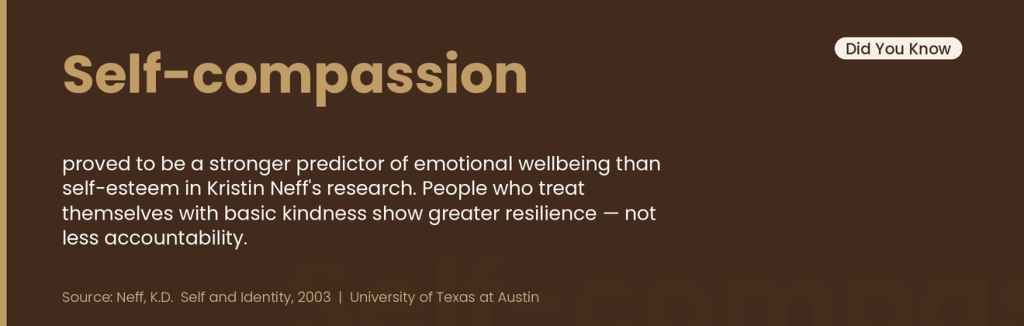
People sometimes worry that softening the inner critic will make them less motivated or less likely to address real problems. The research says the opposite. Kristin Neff at the University of Texas has shown through decades of peer-reviewed work that self-compassion is associated with greater motivation and accountability, not less. When people treat themselves with basic fairness, they are actually more willing to acknowledge mistakes, because they are not terrified of what those mistakes mean about their worth.
Being honest with yourself and being harsh to yourself are not the same thing.
With those myths out of the way, let us look at why this pattern is so common in the first place. Understanding that is often the first thing that helps.
Why Negative Self-Talk Is So Common
Knowing there is a real reason for negative self-talk, and that it is not a character flaw, already changes how many people relate to it. So before we get into what to do about it, it is worth understanding where it actually comes from.
The brain has what researchers call a negativity bias. This simply means the brain is wired to pay more attention to threats and bad experiences than to good ones. For most of human history, it was actually a survival advantage. The people who stayed alert to danger were the ones who stayed alive.
That same wiring is still with us today. The brain notices bad things faster, holds onto them longer, and replays them with more intensity than positive ones. Think about how long a harsh comment can stay with you compared to a compliment. One critical remark from a parent, a teacher, or a peer can sit in the memory for years. Ten kind words often fade within days. That is not weakness. That is just how the brain works.
For many people, that negativity bias does not stay focused on the outside world. It turns inward. The same brain that was scanning for danger starts scanning for what is wrong with us. What we missed. What we said badly. What others might have thought. What could go wrong next.
It is also worth saying clearly: for people who have experienced trauma, chronic stress, or difficult early relationships, this internal scanning can be especially persistent and especially loud. This is your nervous system’s way of responding to genuine harm that happened. The brain learned to stay on guard. For people who have been through a lot, that alarm can be very hard to turn off. This is something that therapy is specifically designed to help with.
Then there is the environment most of us live in now. Social media creates a constant stream of other people’s best moments: their accomplishments, their best photos, their most polished versions of themselves. For adults, this steady diet of comparison quietly feeds self-criticism in ways we often do not notice until we step away from it.
For young people, the effect is deeper. The part of the brain responsible for emotional regulation and perspective-taking is still developing during adolescence. The American Psychological Association has documented clear links between heavy social media use in teenagers and increased rates of negative self-image, anxiety, and depression. A teenager comparing her ordinary Friday to someone else’s highlight reel, without the life experience to question what she is looking at, can develop a harshly critical inner voice very quickly. And without the right tools, that voice can settle in for a long time.
We are not sharing all of this to give negative self-talk a free pass. We are sharing it because if you struggle with it, there are real reasons why. It is a learned pattern, shaped by experiences and circumstances that were largely outside your control. And with the right support and practice, patterns can change.
So what does chronic negative self-talk actually cost you? More than most people realise.

What Negative Self-Talk Does to Your Health
Think about what it is like to spend time with someone who constantly criticises you. Someone who second-guesses your every decision, brings up your failures, and meets your efforts with “not good enough.” Over time, that would wear you down. You would feel more anxious, more withdrawn, less motivated. You might begin to believe what they are saying.
Now consider that this voice lives inside your own head. You cannot leave the room. You cannot mute it. It is there when you wake up and when you are trying to sleep.
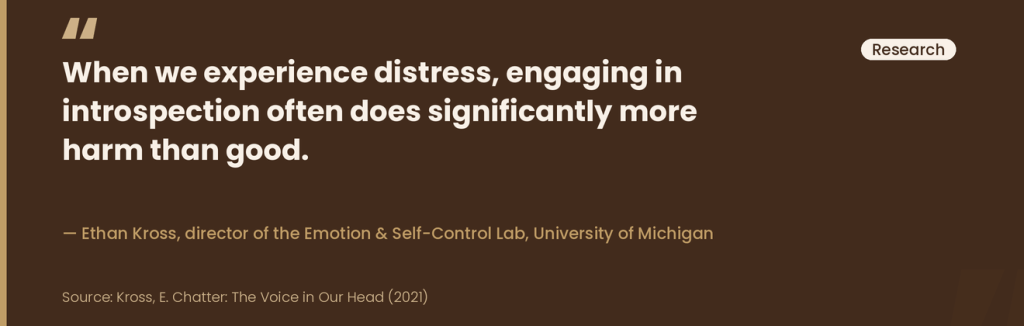
Because the brain does not sharply distinguish between stress that comes from outside and stress that comes from within, the effects of chronic negative self-talk are real and measurable. The research on what this does to the body and mind has been building for decades. Here is what it consistently shows.
Mental health
Susan Nolen-Hoeksema, whose research was published in the Journal of Abnormal Psychology, spent years studying what she called rumination: the pattern of replaying painful experiences and self-critical thoughts in a loop. Her research found that rumination is not just a symptom of depression and anxiety. It actively sustains and worsens them. The inner critic is not responding to a problem. In many cases, it is creating one.
A large-scale study by Killingsworth and Gilbert, published in Science, tracked thousands of people throughout their days and found that a mind drifting toward self-critical thoughts correlates with lower happiness, even when nothing particularly bad is actually happening.
Focus and motivation
Research published in the Journal of Cognitive Enhancement showed that negative self-talk disrupts goal-oriented thinking and reduces motivation. If you have ever noticed that self-criticism makes it harder to actually get things done, there is a real reason for that. The mental energy being used to manage the inner critic is energy that is not available for solving the problem in front of you.
Physical health
Cortisol is the body’s main stress hormone. In short bursts, it helps us respond to challenges. But when the inner critic keeps the stress response running in the background day after day, cortisol levels stay elevated. Over time, this affects sleep quality, digestion, immune function, and cardiovascular health. Studies have linked chronic self-criticism to higher rates of high blood pressure and greater susceptibility to illness.
These are not minor side effects. For people who are already dealing with health challenges, the added weight of a relentlessly critical inner voice is something worth taking seriously.
We are not sharing this to add to your worry. We are sharing it because many people carry this pattern for years without realising what it is costing them, and understanding the full picture is often what finally motivates someone to do something about it.
The good news is that the research on the other side of this is just as strong.
The Real Benefits of Positive Self-Talk
Moving toward a more honest and compassionate inner voice has effects that go well beyond simply feeling a little better about yourself. The same body of research that documents the harm of negative self-talk also documents what changes when the pattern shifts.
Physical health
Health Psychology found that people who engage in healthier self-talk have lower cortisol levels and better cardiovascular health outcomes than those with chronically self-critical patterns. Sleep tends to improve as well, because a calmer inner voice allows the nervous system to actually settle at the end of the day.
Mental health and resilience
People who practise more compassionate self-talk recover from setbacks faster. They are more willing to ask for help when they need it. They tend to show more emotional stability under pressure and bounce back more readily from grief, illness, or major life changes.
Kristin Neff’s research at the University of Texas found that self-compassion is a stronger predictor of emotional wellbeing than self-esteem. The difference matters: self-esteem depends on how you are doing. Self-compassion is available regardless of how you are doing. That is what makes it more stable, and more useful, when things are genuinely hard.
Performance
Sport, Exercise, and Performance Psychology shows that positive self-talk improves performance under pressure, not just in sport but in any situation requiring focus, decision-making, or sustained effort. The reason is straightforward: when the inner critic is loud, mental energy goes toward managing the criticism rather than toward the task at hand. Quieting that critic frees up that capacity.
Relationships
People with healthier self-talk tend to be less reactive in conflict, are able to listen without becoming defensive, and are more secure in their connections. How you treat yourself shapes how you show up with others. Someone who is perpetually harsh on themselves often has a harder time receiving care, trusting relationships, or believing they are worth investing in.
One more thing worth saying directly: healthier self-talk does not mean letting yourself off the hook. In fact, the opposite tends to be true. When you are not afraid that admitting a mistake will be used against you, it becomes much easier to acknowledge it, learn from it, and move on.
There is a meaningful difference between accountability, taking responsibility and learning from it, and punishment, using a mistake as proof of your inadequacy. Most of us were never taught to draw that line. That is part of what the next section is about.
8 Practical Steps to Improve Your Self-Talk
These steps draw from approaches that are widely used in psychotherapy and backed by solid research. They include techniques from Cognitive-Behavioural Therapy (CBT), mindfulness-based practices, self-compassion work, and behavioural approaches. None of them are quick fixes. They are skills, and like any skill, they get easier with practice.
Some people make real progress working through these on their own. Others find that doing this work with a therapist moves things forward more quickly, especially when negative self-talk is connected to past experiences or trauma. Both are valid paths, and we will say more about that at the end of this article.
Step 1: Notice without judging
You cannot change a pattern you have not yet seen clearly. Start paying attention to your self-talk, especially in moments of stress, failure, or comparison. What is the voice actually saying? When does it get loudest? What tends to trigger it?
The most important part of this step is to observe without adding another layer of criticism on top. If you catch a harsh thought and then think, “there I go being negative again, I am so pathetic,” you have added a second problem on top of the first. Just notice. Name it quietly. “There is that voice.” That is enough to start.
Step 2: Use distancing language
Instead of staying in first person, “Why can’t I handle this?” try using your own name or the second person: “[Your name], you have been through hard things before. You got through them.” It sounds unusual at first. But the distance it creates activates a calmer, more problem-focused way of thinking. You move from being inside the storm to being just outside it, where you can see more clearly. This is the same technique many high-performing athletes and leaders use to stay grounded under pressure.
Step 3: Check whether the thought is actually true
This is a core skill from Cognitive-Behavioural Therapy, or CBT. The idea is simple: before accepting a harsh thought as fact, treat it the way you would treat any other claim and look at the evidence.
Say you catch yourself thinking, “I am a bad parent.” A CBT approach would ask:
- What specific evidence do I have that this is true?
- What evidence do I have that it is not true?
- If a fair-minded person looked at the same evidence, what would they conclude?
Step 4: Practise mindfulness
Mindfulness does not mean clearing your mind or sitting in silence for an hour. What it actually means is learning to notice a thought without immediately getting pulled into it or believing it.
JAMA Internal Medicine found that mindfulness-based practice significantly reduces anxiety and depressive symptoms. The reason is not complicated: when you practise observing thoughts without reacting to them automatically, you gradually break the loop between a thought and the emotional spiral that follows it.
Step 5: Treat yourself as you would treat someone you care about
This is a core practice from self-compassion research, and it sounds simple until you actually try it. When a harsh thought appears, ask yourself: “If a close friend came to me with exactly this situation, what would I say to them?”
Most people find that what they would offer a friend is considerably kinder, fairer, and more useful than what they say to themselves. The instruction is to offer that same response to yourself. Out loud if possible. Slowly. You do not have to fully believe it at first. The act of saying it is part of how the pattern changes.
Kristin Neff’s research has shown that people who practise this kind of self-compassion consistently show greater emotional stability, a stronger ability to get through hard things, and higher levels of motivation. Self-compassion is not about lowering your standards. It is about removing the cruelty from the process of meeting those standards.
Step 6: Move your body
Physical movement changes your body chemistry in ways that directly counter the stress response that negative self-talk creates. Exercise reduces cortisol, increases endorphins, and redirects energy that has been building up through cycles of self-criticism. A walk, a run, a gym session, even putting on music and moving around your kitchen, all of it helps.
Proceedings of the National Academy of Sciences found that walking in nature specifically reduces rumination and lowers activity in the brain regions associated with self-focused distress. You do not need to go far. A park, a trail, a quiet street lined with trees is enough. Sometimes getting out of your own head means getting out of the house.
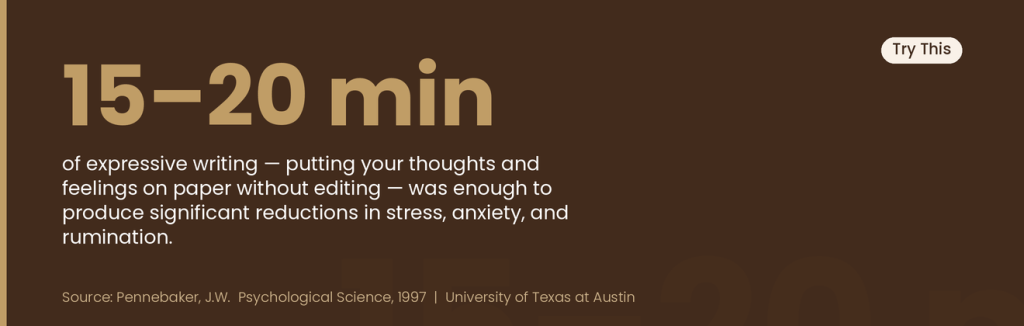
Step 7: Write it down
When the inner critic is running inside your head, it has a captive audience. Writing it down, externalises the thought. You can see it from the outside, examine it, and close the notebook and leave it there.
Step 8: Choose your conversations carefully
Talking through a hard experience with someone you trust is valuable. But not all social support works the same way, and it is worth understanding the difference.
Researchers have identified a pattern called co-rumination, where two people circle the same painful story together without ever moving toward a different perspective. It may feel like a connection. But studies have found that it actually increases anxiety and depression over time. You leave the conversation feeling worse, not better.
What helps is talking with someone who listens fully, validates what you are feeling, and then gently helps you look at the situation from a different angle. Not someone who simply agrees with your harshest interpretation of yourself, and not someone who dismisses your feelings either. That balance is rare. If you have someone like that in your life, lean on them. A therapist offers this kind of support consistently and in a structured way, which is part of why therapy can move things forward when well-meaning conversations cannot.
When the Inner Critic Gets Loud: A Simple In-the-Moment Process
The eight steps above build habits over time. But what do you do right now, when the inner critic is already running and you are in the middle of it?
This five-step process is for those moments. It takes about two minutes and it is a way to interrupt the loop right in the moment.
- Name the thought precisely. Not the feeling. The actual thought. Write it down if you can. “I am having the thought that I am a failure.” That specific phrasing matters. Saying “I am having the thought that” rather than “I am” creates immediate distance between you and what the voice is claiming. You are observing it rather than being it.
- The, name the feeling underneath it. Self-critical thoughts almost always have an emotion driving them. Is it fear? Shame? Disappointment? Embarrassment? Grief? You do not need to fix it. Just identify it. Research in neuroscience has shown that naming an emotion reduces its intensity. This is sometimes called “name it to tame it.”
- Step back using your own name. “[Your name], what would you say to a close friend going through exactly this?” The shift to your name activates the more rational, compassionate thinking you use when you are helping someone else. It is almost always fairer than what you are currently saying to yourself.
- Now say that kinder response to yourself. The one you would offer a friend. Out loud if you can, slowly. You do not have to fully believe it at first. That is normal. Just saying it is part of how the pattern begins to change.
- Notice whether anything shifts, even slightly. You are not looking for a dramatic transformation. You are looking for a small loosening of the certainty the inner critic was carrying. Even that much matters.
Over time, steps one through three start to happen almost automatically. That is the point. You are not eliminating the inner critic. You are changing your relationship with it.
How Self-Talk Travels Through Families
Self-talk does not stay inside your head. Children absorb how the adults around them treat themselves long before they understand the words. A parent who says “I am so stupid” after a small mistake, or who says “I could never do something like that” in front of their child, is not just venting. They are showing their child what it looks like to make a mistake and how to respond to yourself when you do.
Research in developmental psychology has found that children develop their internal sense of self partly by watching how their caregivers speak to themselves and respond to difficulty. The voice a child eventually hears in their own head often echoes what they heard at home. This is not about blame. Most parents do this without realising it. But it is worth being aware of.
When to Get Help
Some negative self-talk runs deep. When it is rooted in past trauma, grief, chronic stress, or long-standing beliefs about your worth, the steps in this article can help, but they may not be enough on their own. It is simply the nature of how deep some of these patterns go, and why certain experiences need more than a self-help guide to work through.
EMDR (Eye Movement Desensitisation and Reprocessing), and compassion-focused therapy are all designed to work directly with the inner critic. Research consistently shows they are effective, and many people find that patterns they have carried for years shift meaningfully once they have the right support.
If the inner critic is affecting how you function at work, how you show up in your relationships, how you parent, or how you get through your days, that is worth taking seriously. You do not have to be in crisis for therapy to be helpful. Many people start simply because they are tired of being the hardest person on themselves in the room.
If you would like to talk about whether therapy might be a good fit, you are welcome to book a free 15-minute consultation with no obligation. You can do that through the link below, or simply call us at 905.214.7363.
Book a free 15-minute consultation | Meet our team | Our services
References
Kross, E. (2021). Chatter: The Voice in Our Head, Why It Matters, and How to Harness It. Crown.
Killingsworth, M. A., & Gilbert, D. T. (2010). A wandering mind is an unhappy mind. Science, 330(6006), 932. https://dash.harvard.edu/handle/1/33431727
Nolen-Hoeksema, S. (2000). The role of rumination in depressive disorders and mixed anxiety/depressive symptoms. Journal of Abnormal Psychology, 109(3), 504–511. https://psycnet.apa.org/doi/10.1037/0021-843X.109.3.504
Kross, E., et al. (2014). Self-talk as a regulatory mechanism: How you do it matters. Journal of Personality and Social Psychology, 106(2), 304–324. https://doi.org/10.1037/a0035173
Goyal, M., et al. (2014). Meditation programs for psychological stress and well-being. JAMA Internal Medicine, 174(3), 357–368. https://jamanetwork.com/journals/jamainternalmedicine/fullarticle/1809754
Bratman, G. N., et al. (2015). Nature experience reduces rumination and subgenual prefrontal cortex activation. Proceedings of the National Academy of Sciences, 112(28), 8567–8572. https://www.ncbi.nlm.nih.gov/pmc/articles/PMC4507237/
Pennebaker, J. W. (1997). Writing about emotional experiences as a therapeutic process. Psychological Science, 8(3), 162–166.
Neff, K. D. (2003). Self-compassion: An alternative conceptualization of a healthy attitude toward oneself. Self and Identity, 2(2), 85–101. https://doi.org/10.1080/15298860309032
American Psychological Association. (2023). Health advisory on social media use in adolescence. https://www.apa.org/topics/social-media-internet/health-advisory-adolescent-social-media-use
Torre, J. B., & Lieberman, M. D. (2018). Putting feelings into words: Affect labelling as implicit emotion regulation. Emotion Review, 10(2), 116–124.implicit emotion regulation. Emotion Review, 10(2), 116–124.Sonnet 4.6Adaptive