
Many people have never heard of Eye Movement Desensitisation and Reprocessing (EMDR) therapy. Others have heard the name but have no idea what it actually involves. And those who do know about it often picture a war veteran or someone who survived a serious assault. That image is understandable. EMDR built its reputation treating post-traumatic stress disorder (PTSD), and for good reason. But it tells only part of the story.
Many people dealing with anxiety, low self-worth, grief, or a painful chapter have never considered EMDR. They may not know it might help.
This article is for those people. It addresses the questions we hear most often, clears up common misunderstandings, and explains what the research actually says about who EMDR can help. If you want a full explanation of how EMDR works, you can read our earlier article, Unlocking Relief: How EMDR Therapy Can Transform Your Life.
So What Is EMDR, Briefly?
EMDR is a structured, evidence-based therapy that helps people process distressing memories. During a session, a trained therapist guides you to think about a specific memory or feeling while your eyes follow a moving stimulus, such as the therapist’s hand, a light, or tapping. This bilateral (two-sided) stimulation appears to help the brain reprocess memories that have become stuck, reducing the emotional weight they carry.
It was developed in the late 1980s by psychologist Francine Shapiro and is now recognised as an effective treatment for PTSD by the World Health Organisation (WHO), the American Psychiatric Association, and the U.S. Department of Veterans Affairs. But the evidence for its use has grown well beyond PTSD.
EMDR Is Not Just for PTSD
This is the part that surprises many people.
A 2021 review of 90 studies, published in Frontiers in Psychology, found that EMDR can help with a wide range of challenges. These include anxiety, depression, addiction, OCD, and even chronic pain.
The Cleveland Clinic lists the following conditions as areas where EMDR is actively used:
- Anxiety disorders, including generalised anxiety, panic disorder, and social anxiety
- Depression, including major depressive disorder
- Obsessive-compulsive disorder (OCD)
- Eating disorders
- Dissociative disorders
- Personality disorders
- Trauma, acute stress disorder, and PTSD
In short, if your current struggles connect in any way to past experiences, whether those experiences were dramatic or not, EMDR may be relevant to you.
You Do Not Have to Have “Big-T” Trauma
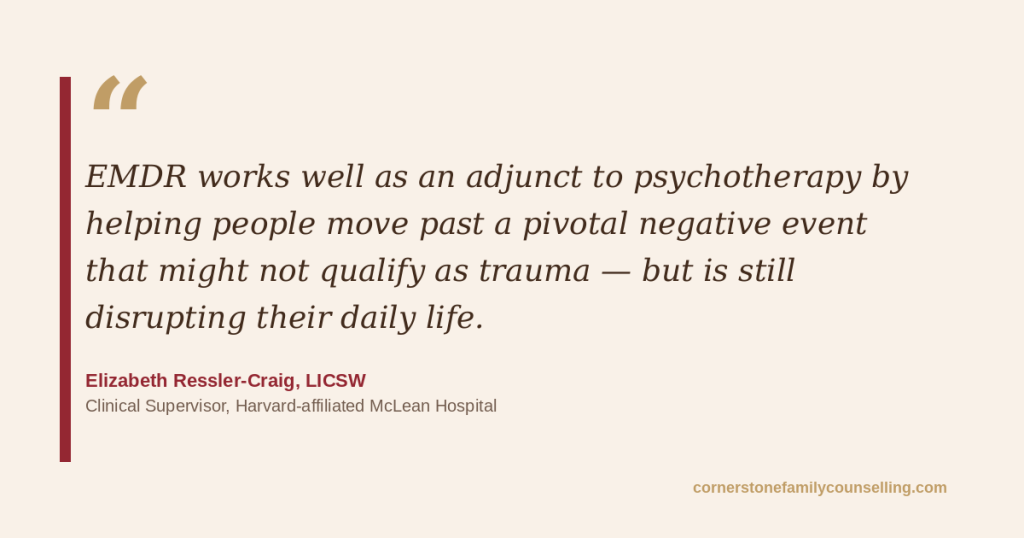
Therapists sometimes distinguish between Big-T trauma (serious accidents, abuse, violence, disaster) and Small-T trauma (repeated criticism, rejection, humiliation, early loss, or neglect). These experiences may not look dramatic from the outside, but it is often the everyday ones — what was said, what was missing, and how we felt in those moments — that stay with us longest and shape how we see ourselves and our place in the world. EMDR can address both.
Someone who has carried a long-standing belief that they are not good enough, not safe, or not lovable often traces that belief back to specific moments. Things that were said. Things that were done. Things that were never there at all. EMDR can help process those moments without requiring you to walk through every detail of what happened.
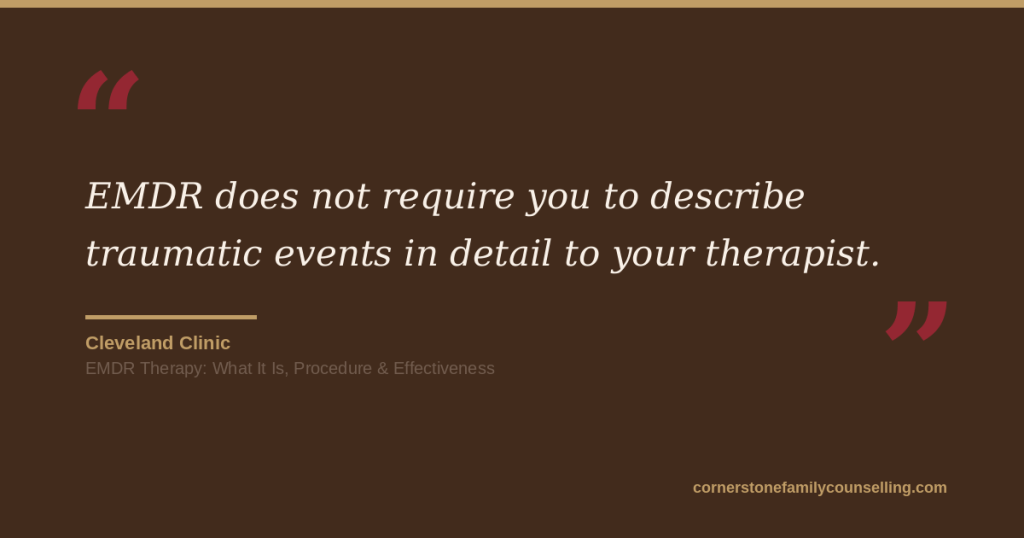
In many cases, you do not need to describe the event to your therapist at all. You hold the memory in mind while the processing happens. You are not reliving it or narrating it. For a lot of people, that distinction matters.
Questions People Actually Ask Before Starting EMDR
Will I have to relive what happened?
Not in the way most people fear. In many cases, you are not required to retell your story in detail or stay in distress for long periods. You bring a memory to mind and let the processing happen while your therapist guides you through bilateral stimulation. Many people find this less overwhelming than traditional talk therapy.
How many sessions will I need?
It depends on what you are working through, and there is no single number that applies to everyone. What the research does show is a general range.
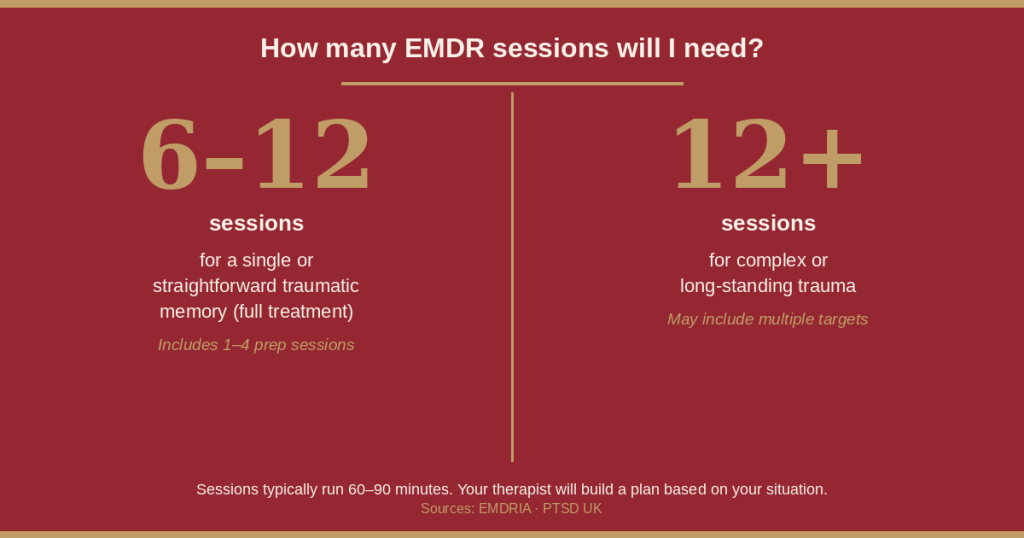
For a single or straightforward traumatic memory, most people can expect somewhere between 6 and 12 sessions in total, including the preparation phase where your therapist ensures you are ready to begin reprocessing. For more complex or long-standing trauma, or where multiple experiences need to be addressed, 12 or more sessions is common.
According to PTSD UK, EMDR is typically delivered one to two times per week. Sessions typically run 60 to 90 minutes. Your therapist will develop a plan based on your specific situation.
Can EMDR be combined with other therapy approaches?
Yes. EMDR is not a standalone system. Therapists often use it alongside other approaches, depending on what a client needs. It fits naturally with talk-based therapies and does not have to replace whatever work you are already doing.
At Cornerstone, two of our therapists are trained in EMDR — Nesrine Riskalla and Lisa Harriott. If you are already working with another therapist at our clinic and want to explore EMDR, we can discuss a referral or a collaborative approach.
Does EMDR work online, or does it need to be in person?
Both options have research support. A 2020 study published in the Journal of EMDR Practice and Research found no significant difference in treatment outcomes between in-person and online EMDR for people with PTSD. A broader 2024 systematic review published in Frontiers in Psychiatry reviewed 16 studies involving over 1,200 participants and found promising outcomes for remote EMDR across age groups.
That said, in-person EMDR has some practical advantages. Your therapist can more easily read your body language, respond to subtle distress, and use a wider range of bilateral stimulation tools. For people working through highly complex or dissociative experiences, in-person sessions are generally recommended.
Online EMDR is a genuinely useful option for those with mobility challenges, demanding schedules, or geographic barriers. At Cornerstone, we offer both, and our therapists will help you decide what makes the most sense for your situation.
Does EMDR work if I do not speak English as my first language?
Yes, and there is interesting research on this. A 2022 study published in the Journal of EMDR Practice and Research explored how bilingual clients can actually benefit from EMDR in meaningful ways. Memories are often encoded in the language a person was using when the experience occurred. A skilled EMDR therapist can work with that, allowing clients to process in their first language even if the therapist does not speak it fluently.
Broader research has also shown that EMDR is effective across cultural contexts and has been used successfully with refugees, immigrant communities, and multilingual populations.
At Cornerstone, our team offers EMDR therapy in English and Arabic. If language accessibility is a factor for you or someone you care about, please mention it when booking.
Can children and youth receive EMDR?
Yes. Cleveland Clinic notes that EMDR can be adapted for people of all ages, including children. The protocol is adjusted to suit younger clients, often involving more creative or play-based elements. Research supports its use with children and adolescents dealing with trauma, anxiety, and other challenges.
Who Is EMDR a Good Fit For?
EMDR may be worth exploring if:
- You have experienced trauma, abuse, accidents, or loss
- You struggle with anxiety or panic that seems tied to past experiences
- You carry a persistent sense of shame, guilt, or worthlessness you cannot shake
- You have tried talk therapy but feel stuck on a particular memory or pattern
- You are dealing with grief, phobias, chronic stress, or OCD
- You are a newcomer or immigrant processing difficult migration experiences
- You want to address emotional blocks that are affecting your relationships or daily life
EMDR is not a fit for everyone. Your therapist will do a thorough intake to understand your history, goals, and readiness before recommending it.
Watch These Videos?
If you are curious about what happens in an EMDR session, we have curated a couple of short videos from reputable sources to give you a clear, plain-language overview of the eight phases of EMDR therapy. EMDRIA is the professional membership organisation for EMDR therapists worldwide and a leading source of research and standards on EMDR practice.
Watch the video on our Video Resources page.
Frequently Asked Questions
Is EMDR scientifically proven?
Yes. EMDR has been studied in dozens of randomised controlled trials and is endorsed by major health organisations worldwide, including the WHO, the American Psychiatric Association, and the UK’s National Institute for Health and Care Excellence (NICE). The research base has grown significantly since its first clinical trial in 1989.
How is EMDR different from talk therapy?
Traditional talk therapy works largely through conversation, reflection, and insight. EMDR works through a structured reprocessing of specific memories using bilateral stimulation. It tends to be more focused on particular memories or events rather than ongoing discussion. It also typically does not involve homework between sessions, which some people find appealing.
Are there any risks to EMDR?
EMDR is considered low-risk. The most common experience between sessions is having heightened feelings or thoughts as memories continue to process. Your therapist will prepare you for this and give you tools to manage it. Sessions never end until you feel settled. If you ever feel overwhelmed, your therapist will adjust the pace.
Do I have to stop other therapy to try EMDR?
Not at all. EMDR can be used alongside other therapeutic approaches. Many clients integrate it into an ongoing therapeutic relationship. If you are already working with a therapist at Cornerstone, speak with them about whether adding EMDR makes sense for your goals.
How do I know if EMDR is right for me?
The best way to find out is through a conversation with a trained therapist. At Cornerstone, we offer a free 15-minute consultation where you can ask questions, share what you are dealing with, and hear whether EMDR might be a good direction. There is no obligation.
Our EMDR-Trained Therapists
At Cornerstone, two of our Registered Psychotherapists specialise in EMDR therapy:
Lisa Harriott brings EMDR into her work with individuals dealing with trauma, anxiety, and emotional patterns that have been difficult to shift through other means.
Nesrine Riskalla works with adults navigating trauma, grief, anxiety, and life transitions. She integrates EMDR with other therapeutic approaches to support deeper healing.
Nesrine works with clients in person at our Mississauga clinic and online across Ontario. Lisa is available online only.
Ready to Connect?
If anything in this article resonated, a conversation is a good next step. You can book a free 15-minute consultation or your first session directly on our website, or reach us at 905-214-7363 or [email protected] (please include your name and contact number and the best time to call).
We serve clients across Mississauga, Brampton, and the broader Peel Region, with in-person sessions at 6341 Mississauga Road and online therapy available across Ontario.
Sources
Corliss, J. (2026). What is EMDR therapy, and who can it help? Harvard Health Publishing.
Cleveland Clinic. (2022). EMDR therapy: What it is, procedure & effectiveness.
EMDR International Association (EMDRIA). Experiencing EMDR therapy.
PTSD UK. How many EMDR sessions will I need?
Kaptan et al. (2024). Remote EMDR therapy: A systematic review. Frontiers in Psychiatry, 14.
de Jongh et al. (2024). State of the science: EMDR therapy. Journal of Traumatic Stress.
EMDR International Association (EMDRIA). Online EMDR therapy: Recent research and overview.