Private therapy in Ontario runs between $150 and $250 per session. For people with insurance coverage for registered psychotherapy, or the financial flexibility to manage that cost, the fee is manageable. For families already stretched by rent, groceries, and childcare, or newcomers still building financial stability here, it can stop the whole process before it starts.
This article is about that second reality: what the affordability gap looks like in Peel Region, why it exists, and what Cornerstone has built over 15 years to address it.
If you or someone you care about is looking for support right now and wondering whether you can afford it, call us at 905.214.7363. We will walk you through your options and help you find something that works. You can also read on to understand what is available and who qualifies.
The Scope of the Problem
The Centre for Addiction and Mental Health (CAMH) reports that one in five Canadians experiences a mental health problem or illness in any given year. That means in a city like Mississauga, on any given day, hundreds of thousands of people are quietly struggling.
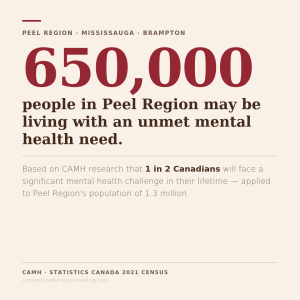
The lifetime picture is even clearer. Research tells us that by the time a person reaches old age, roughly one in two Canadians will have gone through at least one significant mental health challenge at some point in their life. Mental health is not a rare or fringe issue. For most people, it will touch their life or the life of someone they love.
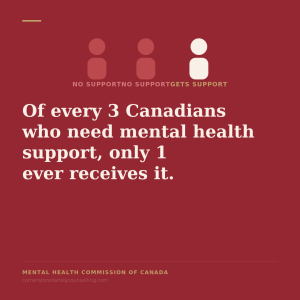
So here is the question we should be asking: of all the people who need support, who is actually getting it?
The Mental Health Commission of Canada estimates that only one in three people who need mental health support ever receive it. Cost is one of the biggest reasons. Long wait times for publicly funded services are another. In Ontario, waits for community mental health programs can stretch for months, and in some cases, longer than a year.
At Cornerstone, most people are seen within a week of reaching out. That is not an accident. It is a result of building a model that takes access seriously from the start.
We do not hesitate to seek medical attention for a broken arm or a sudden illness. We go to the emergency room, we see a surgeon, we get the care we need because we understand that waiting will make it worse. Mental health is no different. Waiting while anxiety deepens, or while a relationship continues to deteriorate, or while grief goes unaddressed has real consequences. It affects how people function at work, how they parent, how they sleep, and how they relate to the people around them. The cost of not getting help shows up in real ways.
What This Looks Like in Peel Region
Peel Region, which includes Mississauga, Brampton, and Caledon, is home to more than 1.3 million people and is one of the most diverse communities in Canada. According to Statistics Canada’s 2021 Census, roughly half of Peel Region residents were born outside of Canada.
Many newcomers arrive carrying an invisible weight. They have left behind family, community, and familiar ways of life. They are building something new in a place where the systems, the culture, and even the words used to describe emotional struggle can feel foreign. That adjustment is genuinely hard, and it rarely gets talked about honestly.
The financial picture adds to this. A significant portion of Peel Region families are working-class or lower-income households. Many are sending money back home to support family abroad. Many are living paycheque to paycheque while also carrying the cultural expectation of appearing to have everything together. The pressure here is not just about what things cost locally. It is about being financially responsible to multiple households across two or more countries, while still trying to keep your own family stable in Canada. When therapy runs $150 to $250 a session on top of all of that, it simply does not make the list. Cultural stigma around seeking help adds another layer. In many communities, struggling emotionally is something you manage privately, not something you bring to a stranger. When that is already the starting point, the cost of therapy is often what closes the door entirely.
Why Private Therapy Costs What It Does
So why does therapy cost what it does? It is a fair question, and understanding the answer matters before we talk about solutions.
Registered therapists in Ontario invest years in education before they are permitted to practise. A master’s degree is the standard entry point. After graduating, therapists must accumulate supervised clinical hours and maintain registration with the College of Registered Psychotherapists of Ontario, known as CRPO. CRPO is the provincial regulatory body that sets professional standards, requires ongoing training, investigates complaints, and protects the public.
Running a clinical practice also involves significant operational costs. Rent. Administrative staff. Professional liability insurance. Secure electronic medical record systems, known as EMR, which are the encrypted digital platforms clinics use to store and protect client health information. Privacy in psychotherapy is regulated, and maintaining it properly costs money.
None of these costs are unreasonable. Together, though, they create a pricing structure that puts quality mental health care out of reach for a significant portion of the population.
What It Actually Takes to Close the Gap
It would be convenient to frame the affordability gap in mental health care as something clinics can simply choose to fix. And while clinics do have choices to make, the honest answer is that this gap is sustained by policy decisions that go well beyond any single organization.
Registered psychotherapy is not covered by OHIP. That is a provincial policy choice, not an inevitability. Most people seeking therapy are paying entirely out of pocket, or relying on employer benefit plans that many lower-income and part-time workers do not have. The result is a system where access to regulated mental health care is quietly tied to employment status and income.
Publicly funded community mental health programs exist, but wait times are too long. When someone has to wait six months or longer to see a counsellor, that is not just an inconvenience. For someone managing escalating stress or a family in crisis, six months is a long time to be left without support. What closes that gap is not innovation alone. It is investment. Government funding, municipal commitment, and community grants are what make it possible for clinics to offer care at reduced or no cost without compromising quality.
The Peel Region has shown what that kind of commitment looks like. Through the CARE Program Grant, the Region has invested directly in the mental health of its most vulnerable residents. That decision has made it possible for people in Peel who rely on Ontario Works, ODSP, and newcomers who are still building stability here, to access free professional counselling when they otherwise could not. We are genuinely grateful for that partnership and for the Region’s willingness to treat mental health as a community priority.
More of this is needed. From the province. From municipalities. And from a healthcare system that still treats mental health as separate from physical health, even as the evidence that they are deeply connected continues to grow.
How Cornerstone Approaches Affordability
Individual clinics cannot solve a systemic problem. But they can make choices that reduce the gap within their reach. That means building multiple fee structures into the model from the start. It means applying for and administering grant funding. It means investing in supervised intern programs that expand capacity without cutting corners on oversight. And it means being honest with the community about what is available and who qualifies. Cornerstone Family Counselling Services has been part of Peel Region for over 15 years. Affordability has been built into our model from the beginning, not as a marketing message but as a practical commitment. Here is what that looks like.
Supervised Intern Therapy
One of the ways we keep therapy accessible is through our supervised intern therapy program. Therapy interns are graduate students completing their clinical training. They work under the direct supervision of our Clinical Director, Father Pishoy Wasfy, who holds a PhD and a Doctor of Counselling and Psychotherapy from Yorkville University.
Sessions with a supervised intern are offered at $50.
This model works well if you want consistent, quality support at a fee that is manageable month to month. Interns bring current, evidence-based training and are often deeply invested in the people they work with. Every session is guided through doctoral-level clinical supervision, which means your care never happens in isolation.
Free Counselling Through the CARE Program
Ontario Works (OW) and the Ontario Disability Support Program (ODSP) are provincial programs that provide financial assistance to people facing hardship or living with a disability. If you are receiving support through either program and you live in Peel Region, you may qualify for free counselling through our CARE Program.
CARE stands for Connection, Acceptance, Resource, and Empowerment.
To qualify, you need to be a current OW or ODSP recipient, or a low-income newcomer who has been in Canada for 12 years or less, and a resident of Peel Region. We do not ask for proof or income verification. If you believe you qualify, that is enough for us to get started.
This program exists because of the Peel Region’s commitment to the mental health of its residents. Funding is provided with appreciation through the CARE Program Grant, with recognition to the Peel Region.
Sliding Scale Fees
If you do not qualify for the CARE Program but are still managing financial pressure, we offer a sliding scale fee structure. Our regular session rate is $170, but what you pay through the sliding scale is adjusted based on what you can reasonably afford. We do ask for basic income verification and the size of the household to determine your fee, but that is the extent of it.
If you are unsure which option fits your situation, call us at 905.214.7363 and we will help you figure it out. We are not here to make this complicated.
And because we know that waiting is its own kind of barrier, most people who reach out to us are seen within a week.
Quality Does Not Change Based on What You Pay
In regulated psychotherapy, quality does not depend on what you pay. It depends on the training, oversight, and standards the clinic holds itself to. Those do not shift based on fee level.
Every therapist at Cornerstone holds a master’s degree in psychotherapy or a related clinical field. Every one of them is registered with CRPO and held to the same professional standards and code of ethics regardless of your fee.
Our Clinical Director, Father Pishoy Wasfy, holds a PhD and a Doctor of Counselling and Psychotherapy from Yorkville University. He oversees the clinical work of our entire team. That oversight applies equally whether you are paying full fee, a sliding scale fee, or receiving therapy through the CARE Program.
Our team also holds training in approaches backed by decades of clinical research. Cognitive Behavioural Therapy, or CBT, helps people identify and work through thought patterns that are causing distress. Eye Movement Desensitization and Reprocessing, known as EMDR, is an evidence-based approach used to treat trauma. Emotionally Focused Therapy, or EFT, helps individuals and couples address the emotional roots of their struggles. These are not interchangeable with general wellness advice. They are structured, studied methods that require proper training and supervision to use well. Please visit us online to learn more about the evidence-based approaches we use at Cornerstone.
We also invest in our team’s ongoing growth through regular clinical training days. These are structured sessions where our therapists work together on skill development, case consultation, and emerging research. This is not a formality. It is part of how we maintain a team that stays current and keeps learning.
Live supervision is a rare clinical training model in Peel Region. At Cornerstone, it is standard. As interns work with clients, they receive real-time clinical guidance from a doctoral-level supervisor, which means any clinical moment that needs attention is addressed then, not the following week. This is a significant commitment. It is also how we ensure that the therapists we help train come out prepared to offer genuinely compassionate, evidence-led care. Everyone benefits — the people they are working with now, and the communities those therapists go on to serve.
We also train our team to communicate in plain language. Clinical jargon puts distance between a therapist and a client at exactly the moment when closeness matters most. Every person who comes to Cornerstone, whether in person or online, should understand what is happening in their care and why.
A Note for Newcomers
If you are new to Canada and reading this, you are welcome here. We wrote an article on how we provide mental health support to newcomers in Peel region.
We currently offer services in English, French, and Arabic. If language has been a barrier to finding help, we hope that changes something for you.
We also understand that in many cultures, seeking help for personal or family struggles carries a weight that people who grew up here may not fully appreciate. Mental health is still misunderstood in many communities. It carries real stigma in others. We do not approach everyone the same way. We take time to understand where a person is coming from and what healing looks like for them.
For those who find spirituality meaningful, we offer Christian faith-integrated counselling. It is never required, but it is available for those who want it.
Why This Matters Beyond Our Clinic
A family in Peel facing job loss and parenting stress should have the same access to quality mental health care as a family in a wealthier part of the region. A newcomer navigating grief over what they left behind should not have to choose between rent and getting support. A person on ODSP should not have to sit on a waitlist for months while their mental health continues to decline.
Over 15 years, we have shown that a different model is possible. Supervised intern therapy, grant-funded free care, sliding scale fees, multilingual services, live supervision, ongoing clinical training, and doctoral-level oversight are not complicated innovations. They are choices any clinical leader can examine in their own practice.
We are glad to talk with any clinic director, community health leader, or healthcare administrator who is curious about how this model works. And if you or someone you know is looking for mental health support in Peel Region, we are here.
Call us at 905.214.7363 or email [email protected]. We will help you figure out the next step. No pressure. No jargon.
Sources and References
- CAMH Mental Health Statistics: https://www.camh.ca/en/driving-change/the-crisis-is-real/mental-health-statistics
- Mental Health Commission of Canada: https://www.mentalhealthcommission.ca/
- Statistics Canada, 2021 Census, Peel Region: https://www12.statcan.gc.ca/census-recensement/2021/
- American Psychological Association, Evidence-Based Practice: https://www.apa.org/about/offices/directorates/guidelines/evidence-based
- College of Registered Psychotherapists of Ontario (CRPO): https://www.crpo.ca/
- Ontario Works Program: https://www.ontario.ca/page/ontario-works
- Ontario Disability Support Program: https://www.ontario.ca/page/ontario-disability-support-program