
When Stress After Moving Becomes Too Much
Moving to a new country brings many changes at once. Stress is common, and for many newcomers, it can grow into anxiety. Sometimes it starts to feel like more than you can carry.
Settlement stress can show up in different ways. Common signs include:
- Worry that shows up most days and does not go away
- Trouble sleeping, or waking up still feeling tired
- Tension in the body, like a tight chest, headaches, or an upset stomach
- Small problems feeling bigger than they used to
- Feeling alone or cut off, even when people are around you
Settlement stress is a normal reaction to a lot of change at once. It does not mean you are weak or failing, and support can help it feel lighter.
You’ve just arrived, and everything depends on you. Housing, work, paperwork, school registration, learning a new transit system, figuring out where to buy groceries that taste like home. Every phone call might mean explaining yourself in a second or third language. Every form might carry consequences you don’t fully understand yet.
For many newcomers to Canada, this period is described as exciting, and it often is. It is also one of the most stressful transitions a person can go through, and it makes complete sense that anxiety shows up during it. This article looks at how that anxiety in newcomers develops, why it can be harder to recognize in newcomer communities specifically, and what tends to help.
Settlement stress is a real, measurable thing
Researchers have a name for the anxiety in newcomers that moving to a new country can bring on: settlement stress. It’s a predictable response to a period packed with unknowns.
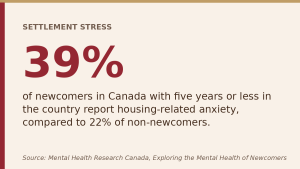
A national survey by Mental Health Research Canada found that newcomers report higher rates of self-rated anxiety than people born in Canada or who have lived here longer, 26 percent compared to 22 percent. Housing insecurity plays a large role in this. Among newcomers with five years or less in Canada, 39 percent report housing-related anxiety, compared to 22 percent of non-newcomers. The same survey found that newcomers are more than twice as likely to say they needed mental health support but did not access it, 11 percent compared to 4 percent.
None of this means something is wrong with you if you’re struggling. It means the transition itself carries real weight, and that weight shows up in the body the same way any other sustained stress does: racing thoughts, trouble sleeping, a short fuse, or a constant low-level sense that something is about to go wrong.
Common triggers for anxiety in newcomers
A few pressures come up again and again for people navigating a new life in Canada.
- Uncertainty about status and paperwork. Waiting on documents, permits, or applications that you have limited control over can keep your nervous system in a state of alert for months at a time, that “on edge” feeling that doesn’t let up.
- Employment and credential recognition. Many newcomers arrive with years of professional experience that isn’t immediately recognized here. Starting over in a new field, or taking a survival job while requalifying, can bring anxiety tied to identity and self-worth, not just finances.
- Language pressure. Even people who speak English or French well often describe a specific kind of exhaustion that comes from living in a second or third language all day, every day. Small interactions, a doctor’s appointment, a parent-teacher meeting, a call with a landlord, can feel higher-stakes than they would in your first language.
- Distance from extended family. In many cultures, extended family shares the load of parenting, decision-making, and daily life. Losing that support network, even temporarily, removes a buffer that used to absorb a lot of everyday stress.
- Raising children in an unfamiliar system. Parents often feel anxious about school systems, discipline norms, and technology that work differently than what they grew up with, on top of everything else they’re managing.
The part that’s harder to talk about: family and cultural expectations
For many newcomer families, there’s an added layer that settlement research alone doesn’t fully capture: what your community expects strength to look like.
In some cultures and families, admitting to anxiety can feel like admitting failure, or like adding a burden to a family that is already carrying a great deal. There can be real concern about how mental health struggles will be perceived, whether by extended family back home, by a faith community, or within your own household. Parents sometimes hold their own anxiety in silence to protect their children from worry, even while quietly falling apart.
This doesn’t make the anxiety any less real, and it doesn’t mean you have to choose between your culture and your mental health. Therapy that understands this context, rather than treating every client the same way regardless of background, tends to make a real difference here. That might mean a therapist who understands why protecting family reputation matters to your family, or who can hold space for faith as part of your coping, without ever pushing it if that’s not what you want.
The “healthy immigrant effect,” and why it can fade
Researchers have documented something called the healthy immigrant effect: people who immigrate often arrive with better physical and mental health than the Canadian-born population, partly because immigration itself favours people who are already relatively healthy and resourced. Over time, though, this advantage tends to erode. The stress of adjusting to a new culture, discrimination, financial strain, and disconnection from established support networks can wear down that initial resilience, resilience meaning the ability to recover from stress or difficulty.
This matters because it means anxiety in newcomer populations often isn’t about pre-existing vulnerability. It’s frequently something that develops here, in response to the accumulated weight of rebuilding a life from the ground up. Recognizing that shift, rather than assuming struggle would have happened regardless, changes how the problem gets addressed.
How this shows up in children
Kids and teens in newcomer families often carry their own version of this settlement stress: navigating a new school system, making friends in a new language, or feeling caught between their family’s culture and the one they’re growing up in. Some take on adult responsibilities early, translating for parents or managing paperwork, which adds weight beyond what’s typical for their age. If you’re noticing changes in your child’s mood, sleep, or behaviour since arriving in Canada, our children and youth therapy page covers what support can look like for younger newcomers specifically.
What tends to help
- Naming it as settlement stress, not weakness. Understanding that this reaction is common among people going through major transitions can reduce the shame, that painful feeling of being “not enough,” that often keeps people from reaching out.
- Support in your language. Being able to describe what you’re feeling in the language that comes most naturally to you removes one more barrier at a moment when you’re already managing many.
- Care that understands your culture. A therapist who understands immigration, family structure, and cultural context can get to the heart of what’s happening faster, without you needing to explain the basics of your background first.
- Small, steady routines. Consistent sleep, regular meals, and small rituals from home, a familiar prayer, a family recipe, a weekly phone call with someone you trust, can help regulate a nervous system that has been on alert for a long time.
- Connecting with community. Where possible, rebuilding pieces of a support network, through a faith community, a cultural association, or a settlement organization, can offset some of the isolation that comes with distance from family.
Cornerstone’s approach
At Cornerstone, we offer therapy in English, French, and Arabic, and our team has particular experience supporting newcomer families across Mississauga, Brampton, and the wider Peel Region. Every therapist holds a master’s degree and is registered with the College of Registered Psychotherapists of Ontario (CRPO), under the clinical supervision of a Doctor of Counselling and Psychotherapy. Faith integration is available if it matters to you, and entirely optional if it doesn’t.
We understand that reaching out for support during a major life transition takes courage, especially if it goes against what you were taught about handling hardship on your own. You don’t need to have the right words ready. That’s what the first conversation is for.
Taking the next step
If settlement stress has started to feel like anxiety that won’t ease up, even as things around you start to stabilize, support is available. You can learn more about anxiety therapy in Mississauga, and if exhaustion feels like the bigger part of the picture, our stress and burnout resources may be a helpful starting point too. For a broader look at how anxiety shows up across different life stages and backgrounds, our main anxiety guide covers the fuller picture.
Sources
- Mental Health Research Canada. Exploring the Mental Health of Newcomers. https://www.mhrc.ca/mh-newcomers
- Immigration, Refugees and Citizenship Canada / Statistics Canada. Mental health and well-being of recent immigrants in Canada: Evidence from the Longitudinal Survey of Immigrants to Canada (LSIC). https://www.canada.ca/en/immigration-refugees-citizenship/corporate/reports-statistics/research/mental-health-well-being-recent-immigrants-canada-evidence-longitudinal-survey-immigrants-canada-lsic.html
- Statistics Canada. Access to mental health consultations by immigrants and refugees in Canada. https://www150.statcan.gc.ca/n1/pub/82-003-x/2021006/article/00001-eng.htm